This post may contain affiliate links. If you make a purchase through these links, we may earn a small commission at no extra cost to you. We only recommend products and tools we genuinely believe can help you better understand, care for, or live well with your Doberman.
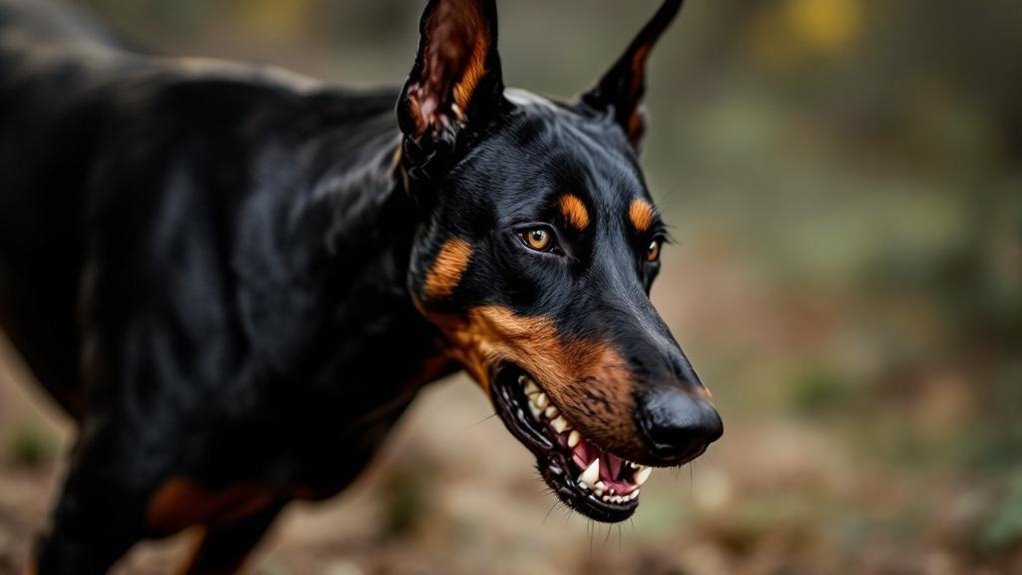
Defensive aggression in Dobermans stems from fear and perceived vulnerability rather than malicious intent, manifesting through warning signals like growling, barking, and body language shifts—tucked tails, averted gazes, and stiff postures—before escalation occurs. You’ll recognize this protective mechanism as distinct from offensive aggression because it’s triggered by environmental stressors, unfamiliar situations, or direct eye contact in confined spaces. Understanding these fear-based responses allows you to implement de-escalation techniques, systematic desensitization, and confidence-building exercises that address the underlying anxiety driving defensive behavior, ultimately reshaping how your dog interprets threat.
- Key Takeaways
- Understanding Defensive Aggression in Dobermans
- How Fear and Insecurity Trigger Defensive Responses
- What Tucked Tails and Averted Gaze Actually Mean
- Why Dobermans Retreat Rather Than Attack
- Defensive vs. Offensive Aggression: The Key Differences
- Early Warning Signs Before Escalation Occurs
- How Environmental Triggers Activate Defensive Behavior
- Strangers, Confined Spaces, and Eye Contact: Common Triggers
- How Stress Amplifies Defensive Reactions in Dobermans
- Building Confidence in Defensive Dobermans
- Step-by-Step: How to Respond When Your Doberman Shows Fear Signals
- Safe Handling: Giving Your Defensive Doberman an Escape Route
- Why Forced Confrontation Worsens Defensive Aggression
- Socialization Strategies for Fear-Based Reactivity
- Does Bite Inhibition Matter for Defensive Dobermans?
- Why Defensive Dobermans Bite Unintended Targets During High-Stress Moments
- Injury-Related Defensive Reactions: Mistaking Pain for Aggression
- Using E-Collar Training to Redirect Defensive Behavior
- Creating Safe Spaces to Lower Reactivity Thresholds
- How Quick Corrections Return Dogs to Baseline Behavior
- Building Trust With Strangers While Preserving Protective Instincts
- Mental Stimulation and Exercise for Managing Defensive Responses
- When Your Defensive Doberman Needs a Professional Trainer
- Frequently Asked Questions
- Conclusion
Key Takeaways
- Defensive aggression in Dobermans stems from fear and perceived vulnerability rather than malicious intent, rooted in survival instincts.
- Observable warning signals include raised hackles, stiff posture, growling, and barking before escalation to biting occurs.
- Early socialization during weeks 3-14 and controlled exposure to varied environments builds confidence and reduces fear-based reactivity.
- De-escalation techniques like maintaining calmness, avoiding sudden movements, and using soft tones help manage defensive encounters effectively.
- Bite inhibition training is essential to control biting force during high-stress scenarios and prevent unintended harm.
Understanding Defensive Aggression in Dobermans
Because Dobermans possess strong survival instincts deeply rooted in their breed history and temperament, they’re predisposed to respond aggressively when they perceive threats to themselves, their territory, or their possessions.
Understanding dog aggression in this breed requires recognizing that defensive responses stem from protective mechanisms rather than inherent malice.
You’ll identify signs of aggression through observable body language: raised hackles signal heightened alert status, while a tense body posture and forward-leaning stance indicate imminent confrontation.
Barking and lunging function as warning signals before escalation to biting. These communicative behaviors serve your Doberman’s evolutionary purpose of deterring perceived threats.
How Fear and Insecurity Trigger Defensive Responses
While defensive aggression in Dobermans often stems from protective instincts tied to territory and possession, fear and insecurity represent equally powerful triggers that activate these same aggressive responses through different psychological pathways. When you expose your Doberman to unfamiliar situations or sudden environmental stimuli, you activate a survival mechanism wherein the dog perceives threat and responds defensively. This fear-based defensive aggression differs fundamentally from territorial aggression; it emerges from the dog’s perceived vulnerability rather than resource protection.
| Fear Trigger | Physical Sign | Behavioral Response | Underlying Cause | Management Strategy |
|---|---|---|---|---|
| Loud noises | Tucked tail | Growling | Environmental sensitivity | Gradual desensitization |
| Strangers | Averted gaze | Defensive posture | Socialization deficit | Controlled exposure |
| Confined spaces | Trembling | Snapping | Loss of control | Safe retreat options |
| Novel objects | Raised hackles | Barking | Uncertainty | Positive association |
| Sudden movement | Pinned ears | Lunging | Startle response | Predictable routines |
Early socialization during puppyhood fundamentally reduces your Doberman’s susceptibility to fear-triggered responses by establishing neural pathways that normalize previously threatening stimuli.
What Tucked Tails and Averted Gaze Actually Mean
When you observe a tucked tail and averted gaze in your Doberman, you’re reading critical body language signals that indicate fear-based defensive responses—signs that your dog feels threatened and is attempting to withdraw from perceived danger rather than confront it directly.
Recognizing these postural cues allows you to intervene before heightened anxiety escalates into reactive or aggressive behavior, since a dog displaying such vulnerability is communicating distress that, if ignored or mishandled, can intensify into defensive aggression.
Reading Body Language Signals
Understanding a Doberman’s body language requires you to recognize that defensive aggression rarely emerges without warning signs, and the most telling indicators often appear in postures and eye contact patterns that communicate fear or submission rather than overt threat.
When you observe a tucked tail, you’re witnessing a clear signal of insecurity; this body posture indicates the dog feels vulnerable and seeks to minimize confrontation.
Similarly, averted gaze demonstrates discomfort, as your Doberman deliberately avoids direct eye contact to de-escalate tension.
Lowered body postures compound these signals, revealing that the dog may become aggressive only if it perceives escape routes blocked by another dog or threat.
Recognizing these defensive indicators before they escalate proves essential for preventing dangerous situations.
Fear-Based Defensive Responses
Because fear triggers the body’s survival mechanisms, a Doberman’s tucked tail and averted gaze represent genuine defensive responses rather than signs of aggression, and you’ll misinterpret your dog’s behavior if you conflate submission with threat.
These fear-based signals originate from instinctual retreat patterns; your Doberman Breed employs physical withdrawal when perceiving threats. A tucked tail demonstrates submission and anxiety, while an averted gaze reflects the dog’s attempt to minimize confrontation by redirecting attention away from stressors.
Understanding these distinctions proves critical because owners frequently mistake defensive posturing for dangerous temperament. Recognizing these body language cues allows you to intervene appropriately, preventing potential escalation into more serious behavioral problems.
Early socialization and consistent training equip your Doberman with confidence to navigate novel situations without fear-based responses.
Preventing Escalation Through Recognition
Your Doberman’s tucked tail and averted gaze function as early warning signals that precede more dangerous defensive behaviors, and recognizing these subtle cues allows you to intervene before escalation occurs.
A tucked tail indicates fear or submission rather than aggression, signaling your dog’s desire to avoid confrontation. Similarly, an averted gaze demonstrates underlying anxiety and discomfort, reflecting your dog’s defensive posture within the situation.
Both behaviors constitute critical markers of defensive aggression that demand immediate attention. Because these signs can escalate rapidly into growling or biting when your dog feels threatened, early recognition becomes essential for maintaining safety.
Understanding this progression—from avoidance signals to assertive behaviors—enables you to manage your Doberman’s environment strategically and prevent confrontation before it intensifies.
Why Dobermans Retreat Rather Than Attack
When a Doberman encounters a threatening situation, its instinctive response typically prioritizes survival over confrontation, manifesting in retreat behaviors that signal fear or discomfort rather than aggressive intent. You’ll notice that defensive aggression in Dobermans operates differently than you might expect; their heightened vigilance and territorial nature actually predispose them toward avoidance. The survival instinct influences this tendency substantially, as you can observe through their flight responses when perceiving risk.
| Retreat Signal | Underlying Cause |
|---|---|
| Tucked tail | Fear response |
| Averted gaze | Discomfort signal |
| Body withdrawal | Threat perception |
| Postural lowering | Submission attempt |
| Distance increase | Safety-seeking behavior |
You’ll find that proper socialization fundamentally reshapes these retreating behaviors, enabling Dobermans to feel more secure. When you invest in early training, you substantially reduce reactive responses, allowing these dogs to distinguish genuine threats from benign situations and respond with measured confidence rather than defensive escalation.
Defensive vs. Offensive Aggression: The Key Differences
The distinction between defensive and offensive aggression in Dobermans—though both rooted in protective instincts—reveals fundamentally different psychological states and behavioral expressions that handlers must recognize to manage these dogs effectively.
Defensive aggression emerges from fear, manifesting through tucked tails, averted gazes, and withdrawal impulses when cornered or threatened. Offensive aggression, conversely, displays assertive posturing: raised tails, forward ears, and confrontational intent signaling dominance.
You’ll find defensive aggression predominates in Dobermans, as their protective instincts typically activate fear-based responses rather than outright confrontation. Understanding these distinctions proves essential because your response strategy differs dramatically.
Recognizing whether your dog exhibits defensive aggression or offensive aggression allows you to de-escalate threats appropriately, prevent conflicts, and guarantee safety for everyone involved.
Early Warning Signs Before Escalation Occurs
Recognizing defensive aggression in Dobermans requires vigilance before escalation occurs, since the progression from discomfort to aggression unfolds through observable signals that handlers can interpret and interrupt.
You’ll notice early warning signs manifesting as pinned ears, tucked tails, and avoidance of eye contact, each indicating the dog’s heightened anxiety.
Early warning signs of defensive aggression include pinned ears, tucked tails, and avoidance of eye contact—each signaling heightened anxiety in your Doberman.
Simultaneously, stiff body posture and raised hackles reveal a heightened state of vigilance, signaling potential defensive reactions.
Growling represents a vital threshold—a direct communication that your Doberman feels threatened and may escalate without intervention.
A professional dog trainer emphasizes that these early warning signs preceding overt aggression create significant intervention windows.
How Environmental Triggers Activate Defensive Behavior
Because Dobermans evolved as working dogs bred to protect and defend, they’re naturally inclined to interpret environmental stimuli through a threat-assessment lens, meaning that specific triggers—unfamiliar people, sudden loud noises, or abrupt movements—activate their defensive instincts by signaling potential dangers to themselves, their territory, or their social group. Understanding how dogs is fairly responsive to these environmental triggers allows you to recognize patterns in your Doberman’s defensive behavior and implement appropriate management strategies. The activation process occurs rapidly, often before conscious evaluation, as your dog’s threat-detection system engages automatically when confronted with unfamiliar stimuli.
| Trigger Type | Response Pattern | Intensity Level |
|---|---|---|
| Unfamiliar persons | Alert, postured stance | Variable |
| Loud noises | Startle, vocalization | High |
| Sudden movements | Reactive positioning | Moderate |
| Territory intrusion | Escalated display | Severe |
| Social group threat | Protective aggression | Critical |
Strangers, Confined Spaces, and Eye Contact: Common Triggers
When you approach a Doberman in a confined space, you’re likely to encounter heightened reactivity because the dog perceives both the stranger’s proximity and the lack of escape routes as simultaneous threats to its territory.
Your eye contact intensifies this response, as Dobermans typically interpret direct gazing as a challenge, which combined with physical confinement can trigger defensive displays ranging from barking and raised hackles to lunging.
These three factors—unfamiliar presence, restricted space, and visual confrontation—create a convergent stressor that amplifies the dog’s protective instincts and impulsive aggressive tendencies if the animal hasn’t received adequate socialization and controlled exposure training.
Stranger Approach and Reactivity
Dobermans’ defensive aggression emerges most visibly during stranger encounters, particularly in situations where the dog’s territorial boundaries feel threatened or compromised. When unfamiliar individuals approach, your Doberman’s vigilance intensifies, triggering defensive responses including barking, lunging, or raised hackles as the dog assesses potential threats to its family member and home.
This reactivity intensifies in confined spaces where your dog can’t retreat or escape, amplifying feelings of vulnerability and territorial protection. Additionally, direct eye contact from strangers activates instinctive defensive mechanisms, as your Doberman perceives such engagement as a challenge to its personal protection role and pack hierarchy.
Understanding these interconnected triggers enables you to spend time implementing early socialization in controlled environments, gradually desensitizing your dog to stranger approaches and improving threat assessment abilities.
Space Confinement and Eye Contact
Two environmental and behavioral factors—spatial restriction and direct visual engagement—interact to intensify your Doberman’s defensive aggression when encountering strangers. These conditions eliminate the dog’s ability to establish safe distance and interpret the stranger’s intentions through normal canine communication patterns.
When confined spaces go along with eye contact, your dog perceives both as territorial challenges rather than neutral social cues. Dog trainers recognize that restricted escape routes amplify reactive responses, forcing your Doberman into a defensive posture.
Direct gazing compounds this reaction, as your dog interprets sustained visual contact as confrontational rather than friendly. These factors work one another into a heightened state of alert defensiveness.
Understanding this interaction allows you to manage exposure strategically, preventing aggressive escalation through environmental modification and gradual desensitization protocols.
How Stress Amplifies Defensive Reactions in Dobermans
Because stress activates the nervous system’s threat-detection mechanisms, Dobermans’ defensive reactions become more pronounced and volatile in response to perceived dangers. When you expose your Doberman to adverse stimuli—visual contact with unfamiliar individuals, loud noises, or environmental disruptions—you trigger a cascade of physiological changes that intensify their vigilance and reactivity. This heightened state compels them toward impulsive behaviors: barking, lunging, and aggressive posturing that reflect their fight-or-flight response. The elevated stress hormones don’t merely increase alertness; they fundamentally alter how your Doberman processes potential threats, making them prone to defensive aggression even in relatively benign situations.
| Stressor Type | Physiological Response | Behavioral Outcome |
|---|---|---|
| Visual stimuli | Nervous system activation | Increased vigilance |
| Environmental changes | Heightened arousal | Defensive positioning |
| Unfamiliar individuals | Cortisol elevation | Impulsive aggression |
Early socialization and proper training mitigate these stress-induced reactions, establishing neural pathways that promote calmness.
Building Confidence in Defensive Dobermans
Transforming a defensive Doberman’s anxiety into genuine confidence requires systematic exposure to varied environments and controlled social interactions, which work together to reshape how your dog processes potential threats.
You’ll find that structured training exercises targeting impulse control and mental stimulation reduce anxiety while fostering calmness. Positive reinforcement—rewarding composed behavior with treats or praise—builds confidence by creating associations between calm responses and favorable outcomes.
Gradual, controlled introductions to unfamiliar people and animals enable your Doberman to reassess situations more positively, diminishing defensive reactivity. Additionally, providing designated safe spaces where your dog maintains control, such as a crate or specific area, supports emotional regulation.
These interconnected strategies address the underlying insecurity driving defensive aggression, establishing a foundation for sustained behavioral improvement.
Step-by-Step: How to Respond When Your Doberman Shows Fear Signals
When your Doberman displays fear signals—such as a tucked tail, averted gaze, or a body posture suggesting withdrawal—you must recognize these early indicators as critical junctures where your response determines whether the fear remains manageable or escalates into defensive aggression.
De-escalation requires you to remain calm and avoid forcing interaction, since forced confrontations amplify your dog’s anxiety and trigger the defensive responses you’re attempting to prevent.
The timing of your intervention proves essential; addressing fear signals at their earliest manifestation, before they intensify into aggressive displays, allows you to redirect your dog’s behavior and create the safe retreat space necessary for emotional regulation.
Recognizing Early Fear Indicators
Fear signals in Dobermans often precede defensive aggression, and learning to identify these early indicators—such as tucked tails, averted gazes, and pinned ears—allows you to intervene before your dog escalates into more dangerous behaviors.
These subtle signals communicate your dog’s discomfort before they resort to defensive measures as a last response.
You should recognize the following early indicators:
- Tucked tails: When your Doberman positions their tail between their hind legs, they’re signaling anxiety and vulnerability.
- Averted gazes: Your dog deliberately avoids direct eye contact, indicating apprehension about confrontation.
- Pinned ears: Ears drawn back against the head demonstrate your dog’s heightened stress response.
Understanding these distinctions enables you to respond appropriately, preventing escalation toward aggression.
De-Escalation Techniques And Timing
Identifying early fear signals in your Doberman represents only the first step in preventing defensive aggression; your response during these vital moments determines whether your dog’s anxiety diminishes or escalates into more dangerous behaviors.
You must maintain a calm demeanor and avoid sudden movements that could heighten their distress. Employ soft, soothing tones while adopting relaxed body language to communicate safety and reduce anxiety levels.
Timing remains essential—provide corrections or distractions only when overt fear signals emerge, never during defensive postures that may trigger miscommunication.
Gradually desensitize your Doberman to feared stimuli by slowly increasing exposure from safe distances, consistently rewarding calm responses. This methodical approach reinforces positive associations and builds confidence, systematically transforming anxiety-driven reactions into measured, controlled behaviors.
Safe Handling: Giving Your Defensive Doberman an Escape Route
Defensive aggression in Dobermans frequently stems from a dog’s perception that it’s trapped or cornered without options, a psychological state that intensifies anxiety and triggers reactive behaviors as a survival mechanism.
You can substantially mitigate these responses by establishing escape routes and safe spaces throughout your environment.
Establishing escape routes and safe spaces substantially mitigates defensive aggression in Dobermans.
Implementing this strategy involves:
- Creating designated retreat areas where your Doberman feels secure and can voluntarily withdraw from stressful encounters, thereby reducing territorial defensive behaviors.
- Allowing supervised access to people and animals, enabling your dog to disengage from escalating situations before aggression emerges.
- Training proactive escape identification, equipping your Doberman to recognize and seek safe zones when overwhelmed.
You’ll foster trust by maintaining composure during stranger encounters and granting your dog autonomy in these interactions, which collectively reduces defensive reactions and promotes behavioral stability in high-stress environments.
Why Forced Confrontation Worsens Defensive Aggression
While establishing escape routes removes the immediate threat of entrapment, you must recognize that forcing your Doberman into confrontations—whether with unfamiliar people, other animals, or stressful situations—actively undermines this progress and creates the very psychological conditions you’re attempting to prevent.
Forced confrontations trigger survival responses in your dog’s nervous system, elevating anxiety to levels where rational behavior becomes impossible. Your Doberman shifts from calm assessment to defensive reactivity, exhibiting submissive signals like tail tucking before potentially escalating to aggression.
This repeated pattern embeds learned defensive aggression, where your dog anticipates threat in future encounters. Each forced confrontation reinforces fear-based associations, transforming temporary defensive responses into chronic behavioral patterns that persist long after the initial stressor disappears.
Socialization Strategies for Fear-Based Reactivity
You’ll find that early exposure and habituation form the foundation of reducing fear-based reactivity, as consistent, positive encounters with diverse people, environments, and stimuli build your Doberman’s confidence and predictability in novel situations.
Controlled environmental encounters—beginning in calm settings and gradually progressing to more complex scenarios—allow you to manage your dog’s stress levels while establishing reliable, non-defensive responses through reward-based associations rather than overwhelming confrontation.
Building confidence through systematic desensitization pairs gradual exposure to specific stressors, such as unfamiliar dogs or loud noises, with positive reinforcement, which fundamentally reshapes your dog’s interpretation of perceived threats from danger signals into neutral or safe cues.
Early Exposure and Habituation
Because fear-based reactivity often develops when dogs haven’t encountered diverse stimuli during their formative months, early socialization becomes a foundational intervention for preventing defensive aggression in Dobermans.
You’ll establish confidence most effectively during the critical developmental window of 3 to 14 weeks, when your dog’s brain remains highly adaptable to novel experiences.
Strategic early exposure involves:
- Controlled environmental variety: Introducing your Doberman to different locations, sounds, and surfaces that normalize unfamiliar stimuli
- Diverse social interactions: Facilitating positive encounters with various people and animals to prevent fear-based defensive responses
- Gradual habituation techniques: Exposing your dog incrementally to potentially stressful situations while monitoring their comfort level
This systematic approach builds your Doberman’s capacity to interpret new experiences as non-threatening, thereby reducing the neurological foundation that generates defensive aggression during adulthood.
Controlled Environmental Encounters
Structured introductions to unfamiliar people and animals in deliberately safe, non-threatening settings form the cornerstone of reducing fear-based reactivity in Dobermans. This approach systematically decouples novel stimuli from the defensive responses that otherwise become entrenched through avoidance and negative experiences.
You’ll monitor your dog’s body language carefully throughout each encounter, identifying stress signals that warrant adjustment before escalation occurs. Gradual exposure combined with positive reinforcement—treats, praise, and calm handling—strengthens your dog’s capacity to process new situations without triggering defensive aggression.
Building Confidence Through Desensitization
When fear-based reactivity drives defensive aggression in Dobermans, desensitization works by systematically reducing the intensity of their emotional response to specific stressors through repeated, controlled exposure at gradually increasing levels of intensity.
You’ll implement this strategy by introducing manageable challenges that allow your dog to acclimate without becoming overwhelmed, thereby rebuilding confidence progressively.
Effective desensitization incorporates:
- Low-level stressor exposure in controlled environments where you regulate stimulus intensity and duration
- Positive reinforcement pairing that associates previously threatening situations with rewarding outcomes, reshaping emotional associations
- Graduated progression advancing complexity only after your Doberman demonstrates consistent calm responses at current difficulty levels
You’ll find that this methodical approach addresses the neurobiological roots of fear-based aggression rather than merely suppressing symptoms.
This establishes lasting behavioral change through repeated success experiences that fundamentally alter your dog’s threat perception.
Does Bite Inhibition Matter for Defensive Dobermans?
How critical is bite inhibition for a Doberman displaying defensive aggression? It’s essential.
Bite inhibition—the dog’s ability to control bite force during heightened stress or fear—directly determines whether your Doberman’s defensive response remains measured or escalates to severe injury. Dogs lacking this control, particularly those from singleton or small litters, face considerably increased risk of causing serious harm when perceiving threats.
You can cultivate bite inhibition through socialization and controlled play with toys, reinforcing appropriate interactions that teach restraint. Training methods involving gradual exposure to stressful stimuli while reinforcing calm behavior prove particularly effective.
Why Defensive Dobermans Bite Unintended Targets During High-Stress Moments
When you encounter a defensive Doberman in high-stress situations, you’re witnessing displacement behavior—a mechanism in which the dog redirects its aggressive response toward an unintended target because the primary threat feels too overwhelming or inaccessible.
This misdirection occurs because your dog’s stress-induced neurological state temporarily compromises its bite inhibition, the learned restraint that normally prevents excessive force. Under extreme duress, even a well-socialized dog may lose this critical control and bite whatever stimulus it perceives as an immediate threat rather than the original source of its fear.
Understanding this pattern requires you to recognize that stress doesn’t simply increase aggression—it fundamentally alters your dog’s capacity to distinguish between legitimate threats and innocent bystanders, making accidental bites during chaotic moments a predictable consequence of defensive reactivity rather than deliberate malice.
Displacement Behavior And Misdirection
Rather than attacking the source of their frustration directly, defensive Dobermans often exhibit displacement behavior—a stress response in which they redirect aggression toward whatever target’s most accessible, whether that’s a nearby person, another animal, or an object in their environment.
This misdirection occurs because you’re observing a neurological response to blocked aggression, where the dog can’t reach the perceived threat.
Several factors intensify this behavior:
- Territorial triggers activate defensive responses when interruptions occur, causing redirected bites toward closest individuals.
- Frustration barriers prevent direct engagement with actual threats, forcing aggression outward unpredictably.
- Inadequate socialization reduces bite inhibition, particularly in single-puppy litters lacking peer interaction.
Understanding these mechanisms clarifies why context matters critically in managing defensive incidents, allowing you to recognize patterns and implement effective prevention strategies rather than attributing misdirected bites solely to inherent aggression.
Stress-Induced Bite Inhibition Loss
Because a Doberman’s capacity to regulate biting force depends on neural pathways that prioritize rational control over instinctive response, overwhelming stress can dismantle this protective mechanism—causing the dog to bite unintended targets during moments when anxiety or perceived threat exceeds the dog’s coping threshold.
When stress levels reach a critical point, your Doberman’s decision-making shifts from calculated aggression to reactive impulse. Situational triggers—unfamiliar people, loud noises, or confined spaces—elevate stress and compromise bite inhibition, making the dog act on instinct rather than deliberate choice.
This stress-induced loss isn’t intentional aggression; it’s neurological dysregulation. Without proper socialization and desensitization training, repeated high-stress exposure reinforces these reactive patterns, progressively weakening your dog’s capacity for behavioral restraint and increasing the likelihood of unintended bites.
Injury-Related Defensive Reactions: Mistaking Pain for Aggression
As pain signals overwhelm a Doberman’s nervous system, defensive biting often emerges not as a manifestation of aggressive temperament but as an instinctual survival mechanism—a protective response hardwired into the dog’s biology to shield itself from perceived threats to its already-compromised body.
You must distinguish between true aggression and pain-induced defensiveness, recognizing that growling and snapping reflect physiological distress rather than behavioral pathology.
Identifying injury-related reactions requires careful observation:
- Examining your dog’s body language for tension, guarding postures, or flinching near injured areas
- Correlating defensive displays with specific physical conditions through veterinary diagnosis
- Documenting behavioral changes that coincide with pain onset or treatment
Understanding this distinction fundamentally shifts how you interpret your Doberman’s defensive responses, enabling you to address underlying injuries rather than misdiagnosing normal protective mechanisms as temperament issues.
Using E-Collar Training to Redirect Defensive Behavior
E-collar training represents a structured intervention designed to interrupt defensive reactions in Dobermans by delivering immediate, controlled corrections that redirect attention away from threat-triggering stimuli and toward handler-directed commands.
You’ll begin in controlled environments at maximum intensity to establish clear associations between the correction and undesirable behavior. Pairing these corrections with high-value rewards—toys or treats—creates competing motivations that encourage calm responses during threatening situations.
As your Doberman progresses, you’ll gradually introduce triggering stimuli while maintaining e-collar consistency, allowing the dog to practice managing defensive instincts systematically.
This method, combined with mental stimulation and impulse control exercises, considerably enhances command responsiveness and diminishes reactive aggression patterns, transforming your dog’s behavioral baseline over time.
Creating Safe Spaces to Lower Reactivity Thresholds
Establishing a designated retreat space represents one of the most foundational interventions you can implement to systematically reduce your Doberman’s defensive reactivity, as it operates on the principle that environmental control directly influences neurological arousal and threat perception.
You’ll create a containment zone where your dog withdraws during high-stress encounters, thereby minimizing exposure to triggering stimuli that would otherwise escalate defensive responses.
Your safe space should incorporate:
- Soft bedding and familiar toys that promote relaxation and lower reactivity thresholds
- Controlled environments using crates or specific rooms to manage exposure during stressful situations
- Regular training sessions within these spaces to reinforce positive behaviors and build confidence
When you combine this environmental management with ongoing socialization and behavioral training, your Doberman learns appropriate responses while maintaining security, creating measurable reductions in defensive aggression.
How Quick Corrections Return Dogs to Baseline Behavior
While creating safe spaces provides your Doberman with environmental scaffolding to manage arousal, the mechanics of real-time behavioral correction operate through a fundamentally different mechanism: immediate feedback that interrupts the defensive response cycle at its moment of initiation.
When you apply corrections the instant aggressive signals emerge—rather than after escalation—you establish a direct association between undesired behavior and consequence, preventing neurological entrenchment of the aggression pattern. Consistency in timing and correction type reinforces this learning, clarifying behavioral boundaries across contexts.
Pairing swift corrections with high-value rewards redirects your dog’s attention and reinforces the calm state you’re establishing. Through repeated practice in controlled environments, your Doberman develops reliable mechanisms for managing reactive impulses, reliably returning to baseline behavior rather than spiraling into defensive episodes.
Building Trust With Strangers While Preserving Protective Instincts
Because protective instinct and social trust operate through distinct neurological pathways, you can cultivate both simultaneously in your Doberman rather than choosing between them.
Though doing so requires understanding how each develops and how they interact. Your approach should incorporate:
- Gradual exposure: Introduce strangers progressively through controlled distances, using leashes initially to manage territorial responses while building positive associations
- Reinforcement protocols: Reward calm behavior during stranger encounters, establishing that unfamiliar individuals signal benign rather than threatening situations
- Structured training: Develop impulse control and obedience through consistent sessions, enabling your dog to remain alert yet composed
This balanced methodology leverages your Doberman’s natural protective capacity while systematically desensitizing defensive reactivity.
It transforms wariness into measured discrimination between genuine threats and ordinary social interaction.
Mental Stimulation and Exercise for Managing Defensive Responses
You’ll find that managing a Doberman’s defensive responses requires a multifaceted approach that addresses both physical and cognitive needs, since excess energy frequently manifests as heightened reactivity to perceived threats.
Through structured physical exercise like running drills and interactive play combined with mental engagement via puzzle toys and training sessions, you create the conditions necessary for channeling your dog’s natural protective instincts into controlled, appropriate behaviors.
Impulse control exercises such as “leave it” and “wait” further reinforce your dog’s ability to pause and respond to your commands rather than react defensively, ultimately establishing the behavioral balance that distinguishes protective vigilance from unmanaged aggression.
Physical Exercise and Energy Discharge
Since Dobermans possess high energy levels and strong physical drives, regular exercise becomes instrumental in preventing the accumulation of excess energy that can intensify defensive aggression tendencies.
You’ll find that structured activities discharge this energy effectively while simultaneously promoting behavioral regulation.
Consider incorporating the following approaches:
- Fetch and running drills, which provide sustained cardiovascular exertion and channeled outlet for physical impulses
- Agility courses, which combine physical demands with cognitive engagement, requiring focus and obedience
- Interactive play sessions, such as tug games, which offer energy release while strengthening your bond and establishing positive behavioral patterns
When you maintain consistent exercise routines, you reduce the likelihood of reactive responses emerging from pent-up tension.
This systematic approach addresses the physiological foundation of defensive aggression, establishing baseline calm that facilitates appropriate stress management across varied situations.
Cognitive Engagement and Impulse Control
While physical exercise addresses the physiological demands of Dobermans’ high-energy temperament, mental stimulation operates on a complementary principle—it channels cognitive capacity toward constructive problem-solving rather than defensive reactivity.
Puzzle toys, scent work, and structured training scenarios engage your dog’s critical thinking, redirecting focus away from perceived threats. This cognitive engagement, combined with physical exertion, cultivates impulse control by providing purposeful outlets for energy and enhancing your Doberman’s capacity to remain calm during stressful encounters.
Impulse control exercises—such as waiting for cues before accessing toys or treats—teach your dog to pause and assess situations rather than react defensively. Mentally rewarding training sessions strengthen your dog’s reliability in managing defensive instincts over time, establishing patterns of thoughtful response instead of reactive aggression.
Structured Activities and Behavioral Balance
Everything a Doberman does—from patrol behaviors to defensive posturing—stems from an interplay between biological predisposition and environmental circumstance, which means that structured activities function as the primary mechanism through which you can reshape this interplay toward stability rather than reactivity.
You’ll find that deliberate engagement channels instinctive energy productively:
- Obedience drills and scent work direct defensive impulses into purposeful tasks, reducing reactive aggression in high-stress situations.
- Interactive play and agility training manage excess energy that otherwise manifests as hypervigilance and threat sensitivity.
- Water activities and running drills establish discipline while promoting focus, creating neurological conditions for emotional regulation.
These activities don’t merely exhaust your Doberman physically; they fundamentally alter how your dog processes environmental stimuli, transforming potential threats into manageable challenges that reinforce calm, collected responses.
When Your Defensive Doberman Needs a Professional Trainer
A defensive Doberman‘s consistent displays of anxiety and reactivity toward strangers or other dogs signal that professional intervention isn’t merely beneficial but often necessary, particularly because these behaviors—rooted in the breed’s innate protective instincts—can intensify without structured guidance and may eventually escalate into genuine aggression that’s considerably harder to reverse.
A trainer experienced with Doberman temperament can implement tailored socialization techniques that address your dog’s heightened vigilance and territorial nature while preserving appropriate protective responses.
Professional evaluation enables you to distinguish between manageable defensive displays and problematic aggression patterns, ensuring correction methods align with your dog’s psychological needs.
Continuous monitoring throughout training establishes whether your efforts produce sustained behavioral improvements, ultimately determining whether your Doberman develops effective coping mechanisms in challenging situations.
Frequently Asked Questions
How to Make a Doberman Less Aggressive?
You’ll reduce your Doberman’s aggression through early socialization, consistent positive reinforcement training, and impulse control exercises. You should expose them regularly to varied environments and people while managing their protective instincts responsibly.
How to Fix Defensive Aggression in Dogs?
You’ll fix defensive aggression by creating safe environments, using positive reinforcement for calm behavior, practicing consistent commands, and gradually exposing your dog to controlled situations with unknown people and animals.
What Are the First Signs of DCM in Dobermans?
You’re noticing your Doberman tires quickly during walks—coincidentally, that’s when lethargy emerges. You’ll spot weakness, reduced exercise tolerance, and a persistent cough. Fainting episodes during excitement signal you’ve spotted DCM’s earliest warnings.
What Is the #1 Most Aggressive Dog Breed?
You’ll find that there’s no definitive #1 most aggressive breed since aggression depends on individual temperament, training, and environment. However, you’ll often see American Pit Bull Terriers, Rottweilers, and Doberman Pinschers mentioned in discussions.
Conclusion
You’ll recognize that defensive aggression in Dobermans functions like a circuit breaker—a protective mechanism that activates when fear signals overwhelm their nervous systems. By understanding the distinction between defensive and offensive responses, implementing consistent training protocols, and providing adequate mental stimulation, you’re fundamentally rewiring their threat perception. Professional intervention becomes necessary when your dog’s defensive threshold remains chronically elevated, requiring specialized behavioral modification to restore equilibrium.